
Fragrance and Fragrances: The Ultimate Guide to Luxury Scent Engineering
Why do you pay a 3,000% markup for a designer logo? It's a provocative question the traditional industry avoids. Most consumers believe a £150 price tag equals quality, yet the liquid inside often costs less than £5 to produce. You've likely felt the frustration of premium fragrances fading before lunch, or felt confused amongst the technical jargon of EDP and EDT. You deserve a scent that lasts without the inflated prestige tax.
This guide reveals the hidden chemistry of luxury scents and teaches you how to curate a high-end fragrance wardrobe on a smart budget. We'll explore the molecular engineering behind longevity and explain why new 2026 allergen regulations are transforming your favourite scents. We're stripping away the mystery to help you find a signature fragrance that prioritises raw quality over expensive marketing. It's time to stop overpaying and start investing in the actual art of the olfactive experience.
Key Takeaways
- Strip away the industry mystery and learn why the "prestige tax" on a £120 bottle is often the most expensive ingredient.
- Identify the sweet spot in scent concentration to ensure your chosen perfume lasts all day instead of fading in an hour.
- Build a strategic collection of fragrance fragrances that adapt to your lifestyle, matching specific notes to work, gym, or social settings.
- Utilise the psychological power of scent to enhance your personal brand and influence how others perceive your authority and confidence.
- Access luxury-grade oil concentrations at a fraction of the cost by prioritising raw craftsmanship over traditional designer marketing.
Decoding the World of Fragrance: More Than Just a Scent
Your scent arrives before you do. It lingers after you leave. It is the ultimate non-verbal calling card. In 2026, the UK market is moving past the era of the "celebrity face." Savvy consumers are demanding scent intelligence. They want to know what is in the bottle, not who is on the billboard. This shift marks a transition from passive consumption to active olfactory architecture. You aren't just buying a liquid; you're designing an aura.
The History of perfume reveals a long-standing link between scent and status. Today, that status is being redefined. It is no longer about how much you spent at a high-street counter. It is about how well you understand the chemistry of your own presence. The industry relies on your ignorance. They spend millions on glossy ads to distract you from mediocre ingredients. By focusing on olfactory architecture, you bypass the fluff. You start looking at molecular weight and oil concentrations. This is where the real value lives.
Why Scent is Your Most Powerful Accessory
The science is direct. Your olfactory bulb is hardwired to the limbic system. This is the brain’s emotional centre. It is why a specific note can trigger a vivid memory or a sudden shift in emotional behaviour. Choosing the right fragrance fragrances isn't just about smelling "nice." It is about psychological engineering. A well-chosen scent can sharpen your focus or project an air of unshakeable authority. There is a profound difference between wearing a scent and owning a signature. One is a costume; the other is an extension of your identity. When you find that match, your confidence doesn't just grow; it solidifies.
The Evolution of British Fragrance Preferences
British tastes are maturing rapidly. We are moving away from the heavy, suffocating florals of the past. The modern UK preference leans toward clean, sophisticated, and often unisex profiles. We are seeing a massive rise in artisan houses that prioritise raw quality over legacy fashion branding. In 2026, the demand is for "beast mode" projection and extreme longevity. People are tired of high-performance fragrance fragrances that vanish by the first coffee break. They want liquid that justifies its place on the shelf through endurance and complexity. We're trading the "designer tax" for genuine olfactory depth.
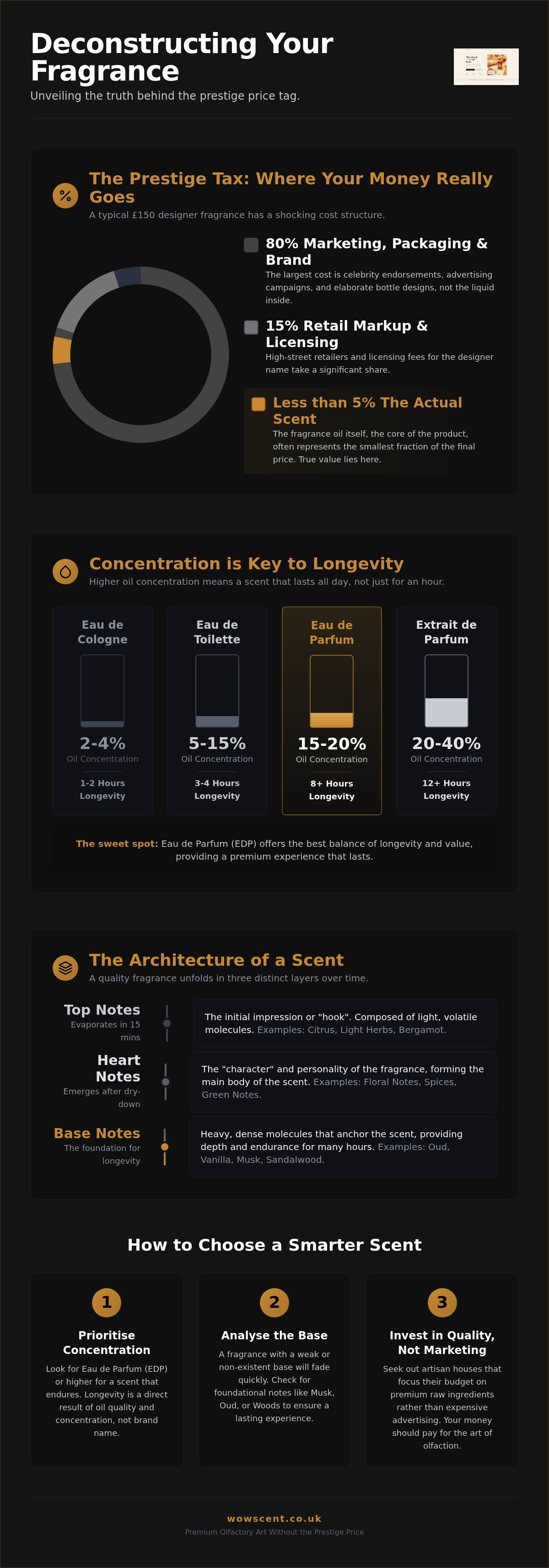
The Insider Reality: Traditional luxury houses often allocate up to 80% of their budget to marketing and bottle design. The actual fragrance oil frequently accounts for less than 5% of the retail price. True luxury is found in the molecular quality of that oil, not the logo on the glass.
Understanding Scent Concentration: EDP, EDT, and Sillage
Most buyers select a bottle based on the brand logo. Smart buyers choose based on the concentration. The hierarchy is a technical ladder: Eau de Cologne (2 to 4%), Eau de Toilette (5 to 15%), Eau de Parfum (15 to 20%), and Extrait de Parfum (20 to 40%). Higher concentration usually translates to better longevity. Sillage is the scent trail left behind by the wearer. If your scent disappears before your first meeting, your concentration is likely too low.
Alcohol is the engine. Essential oils are the fuel. Alcohol provides the "lift" that allows others to smell you. Essential oils provide the substance that stays on the skin. Balance is everything. Too much alcohol and your fragrance fragrances evaporate into nothingness within minutes. Too much oil and the scent sits heavy, lacking the projection needed to make an impression. Whilst FDA fragrance regulations ensure ingredient safety, they do not mandate quality. That is a result of precise scent engineering.
EDP vs EDT: Which Should You Choose?
Eau de Toilette is light and fresh. It is ideal for the office or a humid summer day. Eau de Parfum is the sweet spot for luxury and value. It offers 8 plus hours of wear. It has the density required for a premium experience. Don't assume a high price ensures high concentration. Many designer brands sell EDTs at EDP prices. They rely on brand loyalty to mask a lack of raw materials. You can find better value by looking at engineered artisan collections that prioritise oil over advertising.
The Architecture of a Fragrance: Top, Heart, and Base Notes
Every scent has a timeline. Top notes are the initial "hook." Think citrus or light herbs. They evaporate within 15 minutes. Heart notes are the "character." These emerge after the first dry-down. They define the personality of the scent. Base notes are the "foundation." These are heavy molecules like Oud, Vanilla, or Musk. They provide the longevity. If a fragrance lacks a solid base, it will fail the endurance test. Quality engineering ensures these layers transition seamlessly. You aren't just buying a smell. You're buying a performance. Ensure your fragrance fragrances have the molecular weight to last the distance.
The Luxury Markup: Why Designer Fragrances Cost So Much
The industry relies on your silence. It banks on the idea that price equals prestige. It doesn't. When you pay £120 for a designer bottle, you are participating in a carefully constructed financial illusion. This is the "Prestige Tax." It is a surcharge for a logo, a celebrity face, and a prime position in a department store. The actual liquid inside, the "juice," is often the least expensive component of the product. You are buying a dream, but you are paying for the marketing budget.
Consider the breakdown of that £120 price tag. A typical retailer takes a 40% to 50% margin immediately. That is £50 gone. The marketing campaign, featuring an A-list actor on a Mediterranean beach, consumes another 20%. The elaborate glass bottle and weighted cap often cost more to manufacture than the scent itself. By the time you reach the fragrance oil, you are looking at a value of roughly £3 to £5. Choosing the right fragrance fragrances requires you to look past the glass and focus on the molecular reality of the oil.
Marketing vs Material: The Smart Insider’s View
Legacy houses spend millions on global ad buys. They neglect oil quality to protect their profit margins. They hire "The Nose" (a master perfumer) to create a masterpiece, then dilute it to meet a specific price point. It is a compromise of craftsmanship. Transparent houses like WOW Scent offer a logical alternative for 2026. We remove the celebrity fees. We cut out the middleman. We reinvest those savings directly into the raw materials. The result is a higher concentration of premium ingredients without the traditional markup. Whilst FDA fragrance regulations provide a framework for ingredient safety, they offer no protection against this predatory pricing. Quality is a choice, not a price tag.
The Myth of 'Cheap' vs 'Inexpensive'
There is a vital distinction between a cheap scent and an inexpensive one. Cheapness is a lack of chemical refinement. It is the harsh, alcoholic sting of mass-produced, low-grade liquid. Inexpensive luxury is different. It is the result of smart sourcing and direct-to-consumer logistics. Inspired scents are often engineered for better longevity than the originals because they aren't shackled by the overheads of a legacy fashion label. They can afford to use heavier base molecules and higher oil percentages. There is an ethical case for avoiding overpriced mass-market luxury. You deserve the art of the scent, not the cost of the ad.
Organising Your Fragrance Wardrobe: A Practical Guide
One signature scent is a mistake. It is an outdated concept that limits your personal brand. You wouldn't wear a tuxedo to the gym or flip-flops to a board meeting. Your olfactory choices require the same level of curation. A fragrance wardrobe is a strategy. It is a collection of tools designed for specific environments, moods, and temperatures. By diversifying your rotation, you ensure that your presence is always appropriate and never overwhelming.
Matching families to settings is the first step in scent intelligence. For the office, choose clean, soapy, or light citrus profiles. These provide a professional aura without invading a colleague's personal space. For the gym, stick to fresh aquatics that react well with body heat. Save the heavy ambers and spices for date night. Building a versatile collection of fragrance fragrances means you are prepared for any scenario. It is about control. It is about precision.
Preserve your investment through proper storage. Oxygen, heat, and light are the primary enemies of perfume. If you store your bottles on a sunlit windowsill or in a humid bathroom, you are accelerating their decay. Oxidation destroys the volatile top notes first, leaving you with a flat, distorted version of the original scent. Keep your collection in a cool, dark drawer. This simple habit can extend the life of your scents by years.
Master the three-spray rule for optimal projection. Apply to the pulse points: both sides of the neck and the nape. This creates a sophisticated scent trail, or sillage, that follows you rather than preceding you. It is the difference between being noticed and being notorious.
Seasonal Scents: Matching Notes to the Weather
Temperature dictates performance. In winter, the air is dry and cold. You need heavy molecules like Oud, Amber, and Leather to cut through the chill. These notes have the weight to linger. In summer, these same scents become cloying. Switch to Citrus, Aquatic, and light Floral profiles. These notes thrive in the heat, offering a refreshing contrast to the humidity. Transition through spring and autumn with versatile Green or Woody scents that balance freshness with depth.
Day vs Night: Choosing the Right Intensity
Daytime requires subtlety. Focus on fresh, uplifting notes that project confidence without being aggressive. As the sun sets, increase the complexity. Evening is the time for bold, seductive profiles like Black Orchid or smoky Tobacco. If you are heading straight from the office to an event, master the art of layering. Start with a clean daytime scent and add a deeper, more concentrated EDP in the evening to create a unique, transitional profile.
Ready to build a smarter collection? Explore the La Sera Collection and start your wardrobe with luxury-grade engineering.
WOW Scent: Premium Olfactory Art Without the Prestige Price
Luxury is a molecular reality. It is not a marketing budget. At WOW Scent, we have stripped away the unnecessary. We don't pay for billboards. We don't hire film stars. We invest that capital into the bottle. By focusing on raw quality, we provide premium fragrance fragrances that outperform the legacy labels. We are the UK's destination for the savvy insider who values substance over status. Our mission is simple. We offer high-end confidence without the high-end ad budget.
The traditional model is broken. It prioritises the logo over the liquid. We operate with disruptive transparency. We want you to understand exactly what you are paying for. Every pound you spend with us goes toward scent engineering and premium sourcing. It is a logical choice for a modern audience that refuses to be fooled by a prestige tax. We are the honest rebels of the industry. We are here to prove that quality doesn't require a three-figure markup.
The La Sera Collection: A New Standard of Luxury
The La Sera Collection is our pinnacle. It represents the height of our engineering capabilities. We have balanced high-status notes with pragmatic longevity. These scents are specifically designed for the UK climate. They offer the intensity and sillage required to last from a damp morning commute to a late evening social. Every bottle is a testament to premium sourcing and technical balance. It is the luxury experience you deserve. Only the price has been subtracted.
Join the Revolution: The Brand Representative Program
We don't need celebrity endorsements when we have a community of experts. The Brand Representative Program is our way of empowering "Smart Insiders" across the United Kingdom. It is an opportunity to turn your passion for fragrance fragrances into a rewarding venture. You get direct access to our newest launches. You receive insider training. You become part of a movement that is reclaiming the industry for the consumer. It is about more than just selling. It is about sharing a secret that the big houses want to keep hidden. Visit wowscent.co.uk to join the community and start your journey today.
Master the Art of Scent Intelligence
You now possess the insider tools to bypass the marketing noise. Luxury is a molecular standard, not a status symbol. By understanding the technical hierarchy of concentrations and the reality of industry markups, you've moved from a passive consumer to a savvy curator. You know that sillage and longevity are engineered through quality oils, not celebrity endorsements. It is time to apply this logic to your own collection.
Finding the right balance in your fragrance fragrances shouldn't require a prestige tax. We have simplified the process by focusing on raw craftsmanship. With our premium La Sera Collection and over 500 authentic-inspired scents, we prioritise the liquid inside the bottle. Our UK-based expert support is ready to guide you through every note and layer. Stop paying for the ad and start investing in the art. You are too smart to settle for anything less than excellence.
Discover luxury for less in the WOW Scent collection and reclaim your olfactory identity today. Your signature scent is a choice. Make it a smart one.
Frequently Asked Questions
What is the difference between perfume and fragrance?
Fragrance is the umbrella term for any scented liquid; perfume is a specific concentration. A fragrance can be anything from a light body mist to a dense Extrait. Perfume technically refers to the highest concentration of oils, usually between 20% and 40%. However, a smart buyer knows that "perfume" implies longevity whilst fragrance fragrances describe the actual scent profile itself.
How can I make my fragrance last longer on my skin?
Hydrate your skin before application. Fragrance molecules cling to moisture; dry skin "eats" the scent. Apply an unscented moisturiser or petroleum jelly to pulse points like the wrists and neck before spraying. Don't rub your wrists together. This friction creates heat that breaks down the delicate top notes prematurely. Spray, let it dry, and let the chemistry work naturally.
Why does my favourite perfume smell different than it used to?
Reformulation is the primary reason. New UK and EU cosmetic regulations, specifically the July 2026 deadline for expanded allergen labelling, force manufacturers to replace natural ingredients with synthetic alternatives. Ingredients like Vanillin are now strictly classified as allergens. Your favourite scent hasn't changed because of your nose; it's changed because the industry had to meet updated safety standards to remain on the market.
Is it better to spray fragrance on skin or clothes?
Spray on skin for the full olfactory experience. Your body heat is required to move the scent through its top, heart, and base notes. However, spraying on clothes offers superior longevity as fabric doesn't metabolise the oil. Be careful with delicate materials like silk. A mix of both ensures a balanced sillage that lasts from your morning commute until your evening event.
What are 'inspired' fragrances and are they legal?
Inspired fragrance fragrances are legal alternatives that recreate the olfactory profile of designer scents. Scent profiles cannot be copyrighted under UK law. These houses focus on the liquid rather than trademarked branding or celebrity endorsements. It is a smart way to access premium oil concentrations without paying the 3,000% markup associated with legacy fashion labels and their global advertising budgets.
How should I store my fragrance collection to keep it fresh?
Keep your bottles in a cool, dark, and dry place. The bathroom is the worst location due to constant temperature fluctuations and humidity. Sunlight is equally destructive. UV rays break down the molecular bonds of the perfume oils, causing rapid oxidation. A bedroom drawer or a dedicated cabinet is ideal. Proper storage can preserve a high-quality scent for several years.
What is the best fragrance for a job interview in the UK?
Choose a subtle "skin scent" or a light citrus profile. You want to project cleanliness and professionalism, not overwhelm the room. Avoid heavy ouds, gourmands, or aggressive "beast mode" projectors. A subtle Eau de Toilette that stays within your personal scent bubble is the safest choice. It should be a finishing touch to your attire, not a distraction for the interviewer.
Why can't I smell my own perfume after a few minutes?
This is olfactory fatigue. Your brain is wired to ignore constant stimuli to remain alert for new changes in your environment. Once your nose detects a scent for a prolonged period, it stops sending signals to the brain. Others can still smell you, even if you can't. To reset, try spraying further away from your face or rotating your scents more frequently.

